
Silent Hill Townfall A Humble Review – Konami’s Latest Take on the Horror Franchise

Konami has approached the revival of the Silent Hill franchise quite seriously in recent years, which is great. I missed the initial train, partly because of a lack of hardware (damn PC and Counter-Strike!), and partly because I didn't have time, glued to my TV watching Tarzan: The Epic Adventures, hey, no judgies! Combat sports on PC. After a long period during which the series practically existed only in the memories of horror fans, we got an excellent remake of the second game, followed by Silent Hill f, which showed that the recognizable formula can be successfully transplanted into a completely different cultural setting. Townfall continues this trend of experimentation, but instead of Japan or the famous American small town, the story takes us to an isolated island off the coast of Scotland in 1996.
Screen Burn Interactive, a studio formerly known as No Code, was entrusted with developing this first-person extravaganza; its previous projects, Stories Untold and Observation, left a strong impression on fans of narrative adventures. This choice of developer actually makes a lot of sense. Their games have always relied on atmosphere, unusual interfaces, and exploration through interaction with technology. Silent Hill: Townfall is their most ambitious project so far, and the first full-blooded entry in the series played entirely from a first-person perspective. And I must admit that this perspective suits Silent Hill quite well.
Looking for a more kid-friendly game? Check out our Big Walk review!
The Story Setup of Silent Hill Townfall
Several signs clearly indicate you have ended up in the wrong place. For example, you wake up on the shore of an unknown island; you have no idea how you got there, and a medical IV line is dangling from your arm. Most normal people in such a situation would look for the nearest hospital, police station, or at least someone who could explain what the hell happened. Of course, if you’re a veteran of the Silent Hill games, this is an everyday occurrence.
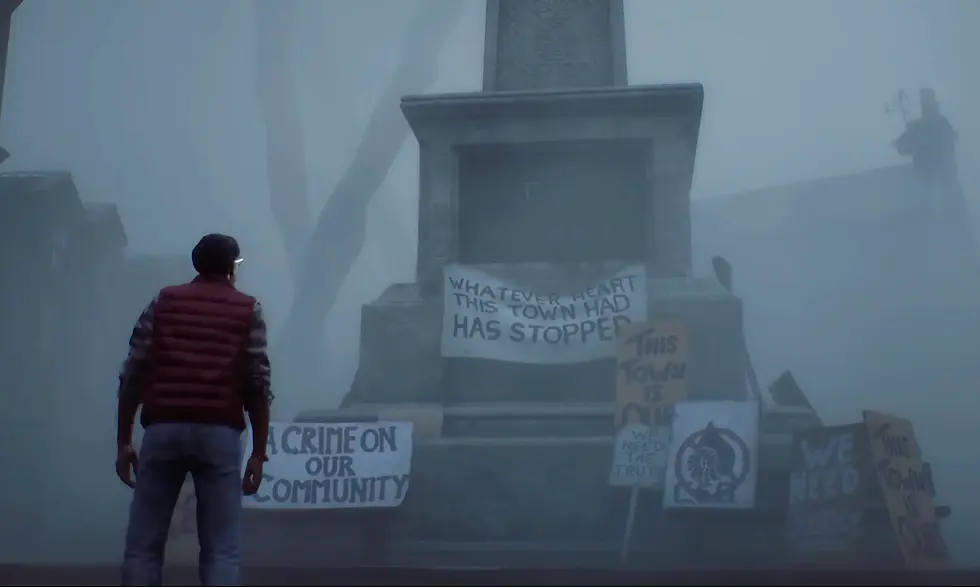
Or if you live in Banovo Brdo. However, the protagonists of the Silent Hill games have long since proven that their survival instinct isn't particularly well developed. So Simon Ordell, the main hero of Townfall, also decides to explore the abandoned Scottish town where obviously nothing is as it should be. Then again, considering how much psychotherapy costs, maybe facing your own demons is cheaper after all, when you can physically beat them to a pulp with a wooden plank.
St. Amelia: A Foggy Town Full of Atmosphere
St. Amelia, where the story unfolds, looks at first glance like a typical sleepy Scottish settlement. Narrow streets, old houses, shops, and buildings that once served the local population are now practically abandoned. The fog is, of course, mandatory, though in this case it is hard to tell how much is the fault of a paranormal catastrophe and how much is just the standard Scottish weather forecast. I’m not kidding; I’ve been to Edinburgh, and the atmosphere is literally identical.
What really works is how Townfall uses this environment. The houses look as if their owners vanished mid-activity. Objects remain in place, documents are scattered about, and almost every room contains some trace of the people who lived there. The game doesn't need to show you a monster every five minutes to remind you something is seriously wrong. The mere fact that the entire settlement has been left without its residents is reason enough for unease. First-person exploration further reinforces this feeling. The field of vision is quite limited, so I often didn’t have an objective picture or the ability to judge what lay around the next corner. The problem is that the game very quickly decides to help you in that situation, and in a way that is at the same time one of its best and most problematic aspects.
The CRTV Device: A Brilliant Idea That Weakens the Tension
Throughout the adventure, Simon uses the CRTV, a small portable television that picks up different signals, reveals hidden information, and helps locate enemies. Fans of the franchise will immediately recognize the idea behind this device. The famous radio from previous games warned of monsters, while the CRTV expands the concept by letting you track them through fog and walls.
The device itself is brilliantly designed. Its screen, the static interference, and the way you change frequencies fit the story's period perfectly. The CRTV is also used to discover clues, receive mysterious messages, and solve certain puzzles. However, that is exactly where the problem arises. Once the player can determine where the enemies are with reasonable reliability, some of the uncertainty disappears. Instead of fearing what might be waiting behind the door, you go full Rainbow Six mode, throwing a drone under the door in the hope of getting the jump on the enemy.

And yes, in several moments I felt like a Sled-wielding psychopath, breaking in and wildly swinging a 5-kilogram sledgehammer that I call Srećko straight into the head of a terrified demon. You can imagine that the horror then takes on the character of some tactical game where YOU are the one the monsters are afraid of! Muhuhuhahahahahahaah… But no no, Doc! Don’t stab me with that needle! I already have a cannula in my arm, see? Feel free to f…OUCH! (he stabs him anyway, in the neck, Doc’s note.) And that is exactly where Townfall starts to lose its pace seriously.
Combat and Stealth in Silent Hill Townfall
Unlike previous Silent Hill titles, which mostly let players fight monsters on relatively equal footing, combat here is meant to be a last resort. Simon can use improvised melee weapons and firearms, but resources are limited, and confrontations are dangerous enough that it is usually wiser to avoid them. Crawlers attack from ambush, the Sekiro-men will truly get on your nerves, and the Weight, which appears already in the first chapter, is invulnerable like the legendary Pyramid Head.
In theory, this is a good approach to survival horror. Let’s be realistic, it isn’t particularly scary when the protagonist can empty three buckets of ammunition into every monster that crosses his path. Leon, I’m looking at you. It is much more unpleasant when you have to decide whether to use the last few bullets (maybe save the last one for yourself?) or try to sneak past the enemy. Unfortunately, Screen Burn insists a little too much on hiding. Certain segments require patiently following enemy patrols, sneaking between cover, and waiting for a suitable moment to pass. When it works, the tension is truly excellent. The problem arises when the game starts repeating the same idea, only with more enemies and less room for error. This is especially true in the game's final chapter.
I am particularly annoyed by moments when opponents can eliminate you almost instantly. At that point, tension turns into frustration, and fear of the unknown is replaced by the question of when I last saved. At some point, you no longer think about the creepy environment and mysterious events; you just want to get past the damn monster so you can finally finish the story. For me, that is Townfall’s biggest flaw. A game that devotes so much attention to atmosphere occasionally destroys it by insisting on mechanics that quickly become tedious. Silent Hill should disturb you with what you see, hear, and gradually discover. Okay, we definitely got that. But when the whole experience turns into repeating several failed attempts to get through the same hallway, the supernatural bogeymen become the smallest problem.
Playing Aggressively: Lowering the Difficulty and Skipping Stealth
Fortunately, when it lets you do more than hide in closets, Townfall shows how good it can be. To be honest, around the middle of the game I decided to change my playstyle completely. I lowered the difficulty and ditched the hiding approach in favor of general slaughter. Since I am forever crippled by playing DOOM and Quake, where I got used to GRINDING UP disgusting creatures and the enemies of the Emperor, this style of play is favorable for the butcher’s nails that hammer away at the cortex of my skull and no longer let me enjoy games normally. Jokes aside, whether it’s because of age or oversaturation, I simply no longer have the patience for sneaking around, especially badly executed sneaking.
Puzzles: Clever Ideas, Uneven Execution

Puzzles are an important part of the adventure, and Screen Burn clearly used the experience gained while developing its previous titles. Many tasks require careful observation of the environment, reading documents, and connecting pieces of information that are not always obviously related. I especially like that solutions often come from completely ordinary objects, which gives exploring rooms a concrete purpose. Still, not all puzzles are equally good.
Several needlessly complicate simple ideas, while some solutions require deductions that the available clues don't sufficiently explain. There is a difference between a puzzle that makes you think and one where you are simply guessing what the author had in mind. Townfall occasionally crosses that line. The ability to adjust the level of assistance partially solves the problem, but it can also take away the satisfaction of finding the solution yourself.
Story, Characters, and Themes of Silent Hill Townfall
The story also leaves a mixed impression. Simon tries to understand his connection to St. Amelia, while through encounters and communication with other characters, he gradually uncovers the events that preceded the catastrophe. Zoe, a nurse trying to reach him, and the mysterious Richard, whose character I somehow can’t connect with through the voice, play a special role. Their past is tied to the island's fate, and as information accumulates, it becomes clear that something far more complex than an ordinary paranormal phenomenon drives the entire situation.
Townfall deals with guilt, responsibility, and social problems, including how large corporations treat local communities. Such themes have potential, especially in a series that has always used horror to explore human weaknesses. However, they aren't treated equally well throughout the campaign. And no, I don’t mean that in the context of your guilt, which gets personalized in the form of a monster hammering you over the head. Simon is particularly problematic. His mysterious past should be one of the main reasons to keep playing, but for a long time he remains a rather uninteresting protagonist. The circumstances that lead other residents of St. Amelia to do what they do attract much more attention, while Simon often seems like someone there primarily to connect the different parts of the story.
The finale tries to tie together the previous events and offer answers, but it doesn’t fully justify all the expectations the game previously creates. The whole narration is executed somehow… clumsily. There are several excellent storytelling moments; however, it lacks a stronger emotional connection with the central characters. It’s a shame, because at its best Silent Hill left a much deeper impression, thanks to the personal tragedies of its protagonists.
Graphics, Sound, and Music: Technical Presentation
Technically, the situation is considerably better. Screen Burn has created a very convincing environment, with an enormous amount of small details. The interiors are especially impressive, and the way objects from the nineties are presented contributes greatly to the atmosphere. The visual identity successfully combines realistic locations with the franchise’s recognizable paranormal elements. The sound is perhaps the best aspect of the presentation, as expected.
The creaking floors, distant footsteps, and other ambient effects constantly remind you that Simon is not safe, even when there is no immediate danger. The musical score is credited to Pilotpriest, Anthony Scott Burns, who successfully matches the game's atmosphere, though fans of the series will probably miss Akira Yamaoka's recognizable musical signature.
DualSense Controller Features on PS5
The DualSense controller is also interesting, especially the haptic vibrations and the ability to adjust the CRTV device’s frequencies with controller movements. They aren’t revolutionary additions, but they nicely contribute to the feeling that you are really handling old electronic equipment. Of course, if you find them annoying, you can adjust the controls to your preferences. A special touch I liked is the rustling of static from the controller when I enter a zone with a monster, accompanied by vibration.
Completing the campaign takes roughly ten hours, which is quite decent for this type of horror. Honestly, given how tedious some stealth segments can be, an additional ten hours probably wouldn't add much to the game's overall quality.
In Conclusion: Is Silent Hill: Townfall Worth Playing?

Silent Hill: Townfall is an interesting experiment that occasionally delivers exactly what fans of the franchise expect, but too often allows its weaker mechanics to spoil an excellent atmosphere. St. Amelia is a fantastically designed environment, the sound presentation deserves all praise, and some puzzles and the way the CRTV device is used are truly good ideas. However, the excessive insistence on hiding, frustrating encounters with enemies, and a story that lacks a stronger emotional ending prevent Townfall from approaching the best entries in the series.
Still, this remains a quality psychological horror that is worth playing, especially if you prefer exploration, puzzle solving, and a slower pace over direct action. Screen Burn shows it understands the atmosphere of Silent Hill, but it hasn’t yet found the ideal way to turn it into an equally engaging experience from beginning to end. When Townfall works, it can be extremely unsettling, mysterious, and interesting. When it doesn’t, it feels like you’re stuck in a bad stealth game from the early 2000s. And for someone who came to be scared of monsters, it’s rather disheartening when the biggest enemy becomes their own patience.
Silent Hill: Townfall has excellent atmosphere and several great ideas, but its excessive reliance on stealth and uneven story turn a potentially top-tier horror into a good adventure.
Gemini AI Summary
Silent Hill: Townfall is a first-person psychological horror game from Screen Burn Interactive (formerly No Code), set in 1996 on the abandoned island town of St. Amelia off the Scottish coast. Players control Simon Ordell, who wakes up with an IV line in his arm and investigates the vanished community with the help of the CRTV, a portable TV that detects monsters and reveals clues. The reviewer praises the superb atmosphere, detailed 90s-era environments, outstanding sound design, Pilotpriest’s score, DualSense haptic features, and clever object-based puzzles. The main criticisms are the heavy emphasis on stealth, near-instant deaths, a CRTV that reduces tension by exposing enemy positions, uneven puzzle clarity, a bland protagonist, and a story with a weak emotional finale. The campaign lasts about ten hours. The final verdict is 7/10: a worthwhile atmospheric horror for fans of exploration and slower pacing, held back by repetitive mechanics.
My Rating
7.2/10: Townfall earns it for its superb atmosphere, sound design, and the clever CRTV device, but repetitive stealth, instant-death encounters, and an emotionally weak story keep it from reaching the series’ best.
Recommended Age
I’d recommend it for ages 18+ (17 at the very youngest, with parental involvement). It is a psychological horror with disturbing monsters, themes of guilt and trauma, medical imagery (IV lines, needles), and sustained dread, which is too intense for children and younger teens. Please check the official PEGI/ESRB rating at release, since I’m basing this on the text’s content rather than a confirmed rating.